KILMOZ is an art and research practice born from the affinity between the ways in which kilim and mosaic construct a surface. The conceptual starting point of the work emerged toward the end of 2024. During my personal practice in mosaic, which had begun earlier, I recognised that the geometric structure of Anatolian kilims and tessera-based mosaic surfaces share not only a visual relationship but also a structural one.
In both forms of making, the whole is created by placing small units together in an ordered way. In a kilim, warp, weft and yarn construct the surface; in a mosaic, stone and tessera do so. At first this common ground may appear to be merely a technical resemblance. As the work developed, however, questions concerning how material shapes pattern, how geometry changes through the method of production, and how cultural memory can be reread across different surfaces became the foundation of KILMOZ.
 © İBRAHİM HANÇERKIRAN · KILMOZ
The aim of KILMOZ is not to transfer a historical kilim mechanically into stone. Nor is it to place an Anatolian motif at the centre of a Roman mosaic and combine two traditions at a superficial level. What interests me is how two distinct material cultures can enter into a relationship on the same surface without losing their individual character.
Here, the kilim is not simply a source of motifs. Mosaic is not merely a technique of application. Each is a separate surface language that determines the conceptual and physical structure of KILMOZ.
Repetition, rhythm, colour, geometric order and symbolic motifs found in Anatolian weaving are reconsidered through the texture of natural stone, the scale of the tessera and the physical logic of the mosaic surface. The ram’s horn, eye, fertility symbol and other regional geometric arrangements are not copied directly. They are approached within a new material system while respecting the visual memory to which they belong.
Natural stone plays an important role in this process. The pores of travertine, the veins of marble, the darkness of basalt and the subtle tonal variations within each stone become part of the composition. On a digital surface, two areas carrying the same colour code may be identical. In natural stone, however, no two tesserae are exact equivalents. This difference makes the character of the material visible across the KILMOZ surface.
 © İBRAHİM HANÇERKIRAN · KILMOZ
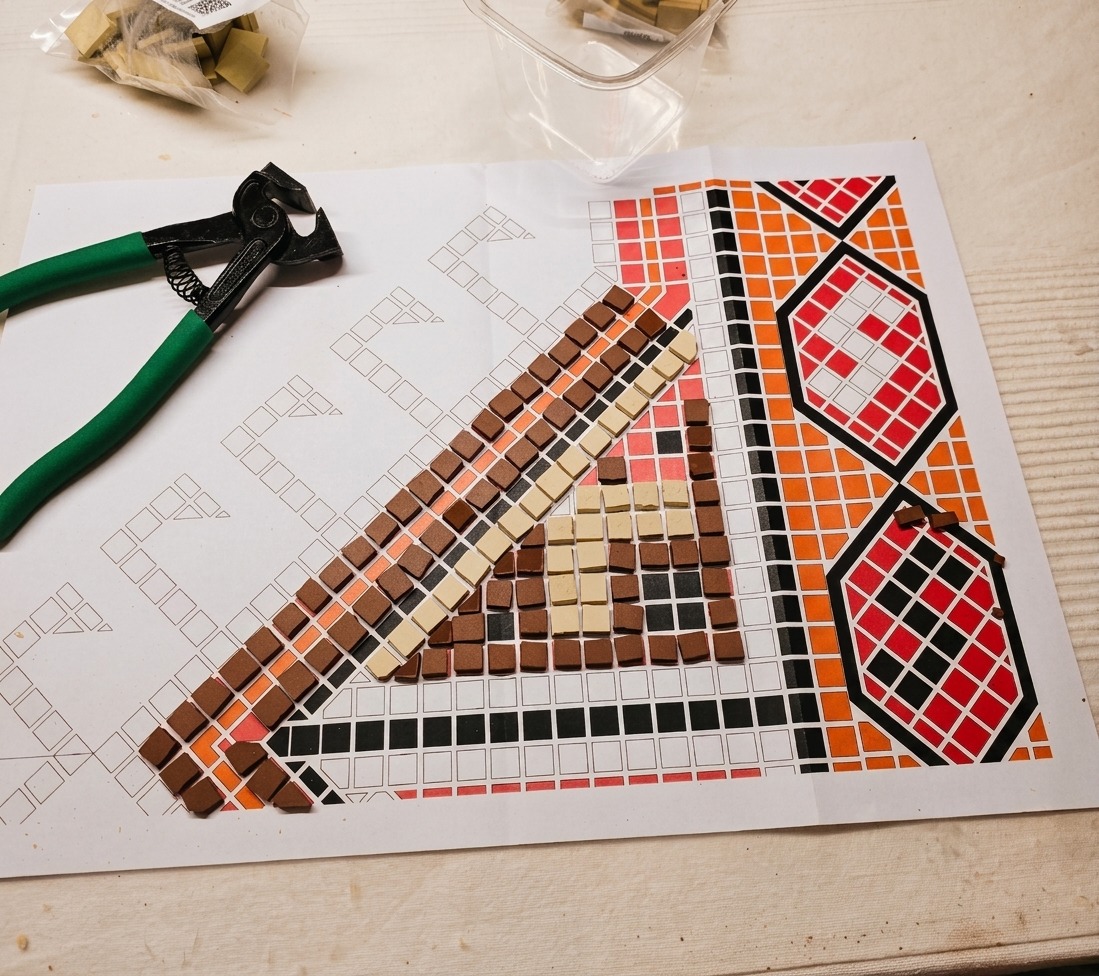
The scale of the tessera also directly affects the form of the design. The stone units of approximately 14 × 14 mm used in the first works establish particular limits for line and pattern. Curves may become stepped, details may need to be simplified, and some forms must be proportioned again. I regard this technical limitation not as a deficiency but as part of the design. In traditional weaving too, much of its geometry developed within the conditions imposed by material and method of production.
Another field of KILMOZ research brings the Roman mosaic tradition of borders and rhythm together with the central or repeated compositions of Anatolian textile memory on the same surface. Geometric borders such as the meander and guilloche may enter into dialogue with Anatolian motifs placed at the centre. This is not, however, a fixed formula for KILMOZ. Each work is reconsidered according to its pattern, stone and spatial context.
I do not conceive KILMOZ solely as a collection of independent art panels. I also see it as a field of research that can be applied to floors, walls, façades, entrances, public spaces and architectural surfaces. In relation to urban memory, spatial identity and cultural heritage, the reappearance of local weaving traditions on contemporary architectural surfaces carries significant potential.
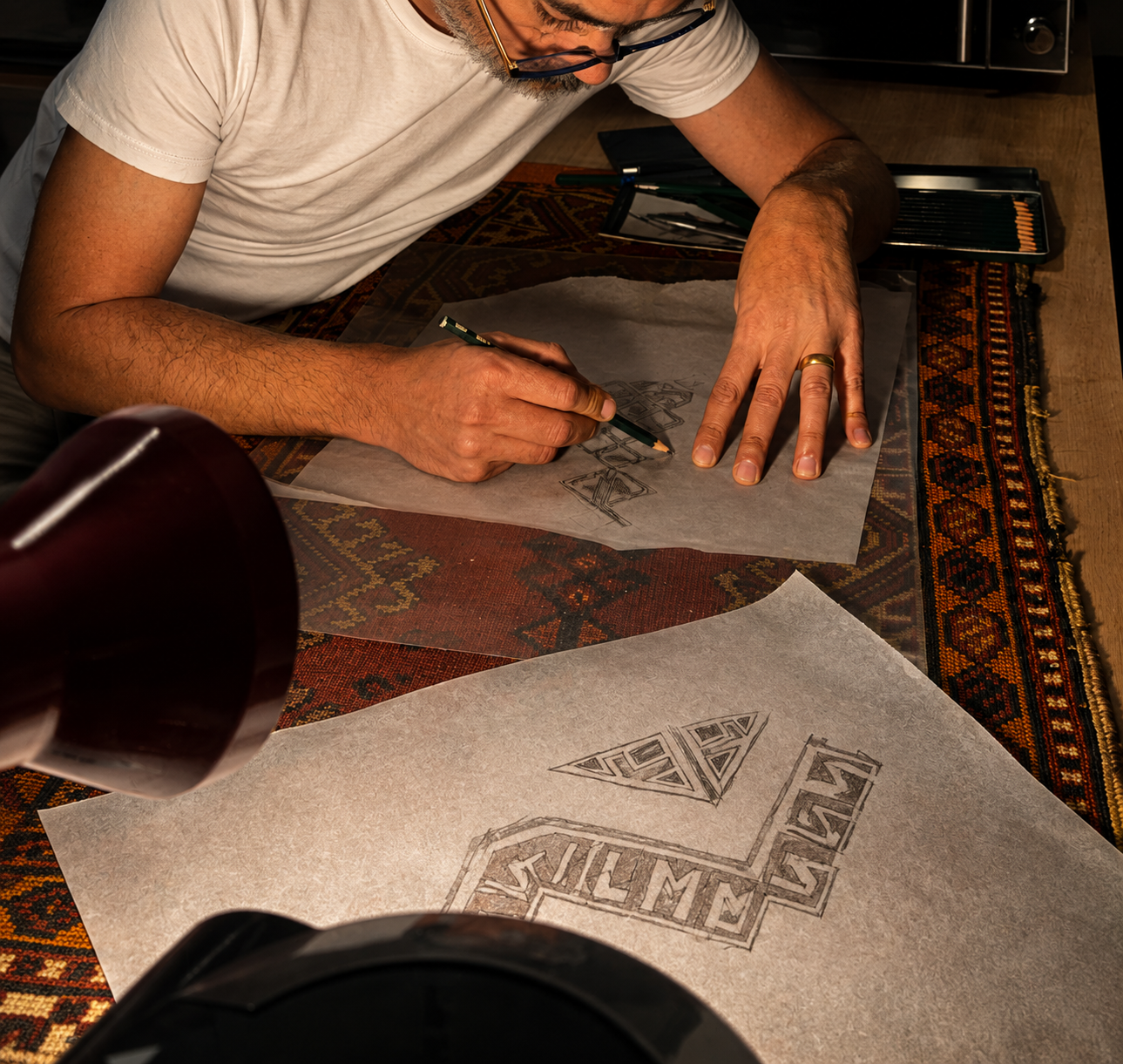
KILMOZ did not originate as a commercial undertaking. I understand the work primarily as a research practice concerned with material, pattern, craft, surface and cultural memory. The finished work is only one part of the practice; documenting source textiles, drawing studies, selecting stone, determining tessera scale and recording the making process are equally important.
I do not wish to confine KILMOZ within definitive boundaries today, because the work continues to develop. In its simplest present definition:
KILMOZ is a contemporary art practice that investigates and reinterprets the patterns, rhythm, geometry and cultural memory of Anatolian and wider weaving cultures through the material logic of natural stone, tesserae and the mosaic surface.
In one, the surface is constructed with thread.
In the other, with stone.
KILMOZ investigates what these two surfaces might say to one another.
İBRAHİM HANÇERKIRAN